
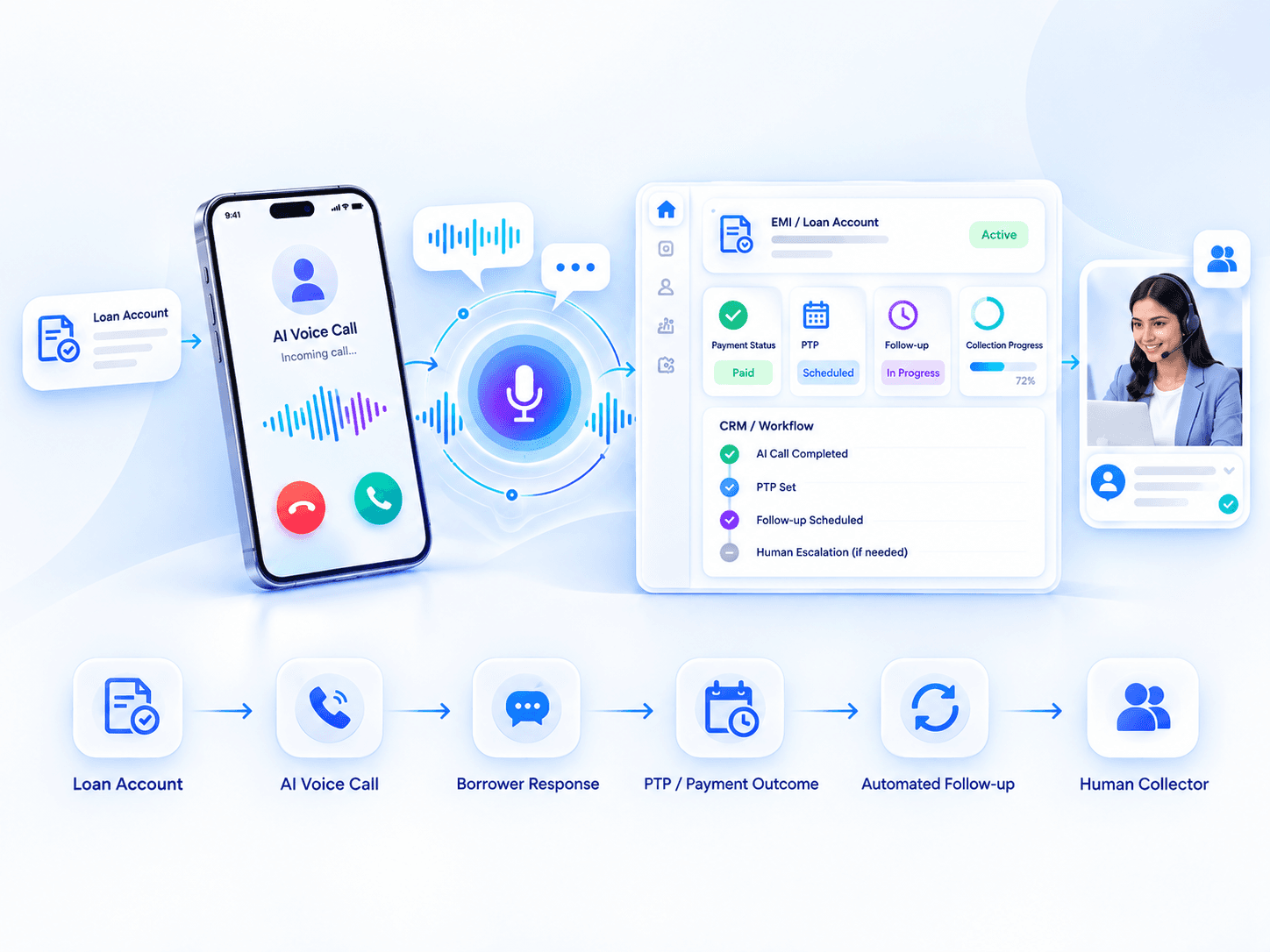
How AI Voice Agents Automate Loan Collections for NBFCs
Loan collections are not simply about making more calls. For NBFCs, effective collections depend on reaching the right borrower at the right time, having a consistent conversation, understanding why a payment was missed, capturing a Promise to Pay (PTP), and following up when that promise is not met.
As loan portfolios grow, doing all of this manually becomes increasingly difficult. Collection teams have to manage large account lists, repeated follow-ups, different borrower responses, multiple languages, and strict requirements around how recovery calls are conducted.
This is where AI Voice Agents can become part of the collection workflow.
Instead of replacing the entire collections team, a Voice AI Agent can take care of repetitive, high-volume conversations such as payment reminders, overdue follow-ups and PTP confirmation, while human collectors focus on cases that require judgment, negotiation or escalation.
GoodBox's AI Collection Agent is designed around this type of workflow, combining automated voice outreach with account information, follow-up actions and CRM updates.
Why Loan Collection Calls Are Difficult to Scale
Traditional collection operations often depend heavily on human calling teams. That approach can work well at smaller volumes, but the operational challenge increases as the number of overdue accounts grows.
A collector may have to:
Identify which accounts need attention.
Make repeated outbound calls.
Explain the outstanding amount.
Understand the borrower's reason for non-payment.
Record a Promise to Pay.
Remember to follow up on the promised date.
Update the CRM after every interaction.
Escalate disputed or sensitive cases.
The problem is not necessarily that these tasks are individually complicated. It is that they happen thousands of times across a portfolio.
A missed follow-up can mean a borrower who was ready to pay is contacted too late. A poorly recorded call can mean the next collector does not have the right context. And inconsistent conversations can create operational and compliance risks.
There is another constraint: RBI guidance states that regulated entities and their recovery agents should not make recovery calls before 8:00 a.m. or after 7:00 p.m., and they must avoid intimidation, harassment, persistent calling and other inappropriate recovery practices.
For a large portfolio, that makes how efficiently a lender uses its available calling window just as important as the number of collectors it has.
What Is an AI Voice Agent?
An AI Voice Agent is software that can conduct a phone conversation, understand what the customer is saying, connect to relevant business systems and take predefined actions based on the conversation.
That makes it different from a traditional Interactive Voice Response (IVR) system.
Traditional IVR | Rule-Based Voice Bot | AI Voice Agent |
|---|---|---|
Customer chooses menu options | Customer speaks within predefined flows | Customer can speak naturally |
Mainly routes calls | Follows fixed rules | Understands conversational intent |
Limited context | Limited conversation flexibility | Maintains context during a conversation |
Usually designed for routing | Performs predefined actions | Can trigger business workflows |
Human transfer is usually menu-based | Transfer based on fixed rules | Can escalate based on predefined conditions |
A modern Voice AI workflow generally involves speech recognition, an AI reasoning layer and speech generation. The agent listens to the customer, interprets the request, checks relevant information when required, formulates a response and continues the conversation. GoodBox describes this workflow as a combination of live conversation, business-system integration and actions taken within the call.
The important distinction is this:
A voice agent should not simply sound human. It should be able to move the business process forward.
For collections, that could mean capturing a PTP, recording the reason for non-payment, triggering a follow-up or escalating the conversation to a human collector.
How an AI Collection Call Works
Consider a simple example.
A borrower has an overdue EMI. The collections system identifies the account and sends it into an approved outreach workflow.
The AI agent can then follow a process such as:
Overdue account → Voice call → Understand response → Take permitted action → Record outcome → Follow up or escalate
1. Account information is prepared
The collection workflow provides the information required for the conversation, such as the relevant account identifier, payment status and applicable communication flow.
2. The AI makes the call
The Voice AI Agent initiates the outbound call through the configured telephony infrastructure.
3. The borrower responds
Instead of forcing the borrower through a fixed menu, the agent can handle a conversational response.
For example:
“I can't pay today. I'll be able to make the payment on Friday.”
The agent can identify this as a repayment commitment rather than simply treating it as a failed call.
4. The agent captures the outcome
The conversation can be structured into useful information such as:
Payment commitment: Friday
Intent: Willing to pay
Reason: Temporary delay
Next action: Follow up on commitment date
5. The workflow continues
The outcome can be written back into the relevant system and used to determine the next step.
If the borrower keeps the commitment, the workflow can move toward closure.
If the commitment is missed, the account can enter a follow-up journey.
If the conversation involves a dispute or another situation outside the agent's permitted scope, it can be escalated to a human collector.
That is where Voice AI becomes more than an automated calling tool: the conversation becomes part of the collection workflow rather than an isolated phone call.
Where AI Voice Agents Can Help Across the Collection Lifecycle
Voice AI does not have to be limited to late-stage recovery.
Pre-Due Payment Reminders
Before an EMI becomes overdue, automated reminders can help customers remember the upcoming payment.
A simple reminder conversation might confirm the upcoming due date and direct the borrower toward the lender's established payment process.
Early Delinquency
When an account becomes overdue, the agent can initiate the first-level conversation.
The objective could be to understand whether the borrower:
Forgot the payment date.
Has already made a payment that has not yet reflected.
Is facing a temporary cash-flow problem.
Needs information about the outstanding amount.
Is willing to make a payment on a specific date.
This information can then be captured systematically instead of remaining only in a collector's notes.
Promise-to-Pay Capture
PTP is particularly important because a collection conversation does not necessarily end when the borrower says:
“I'll pay tomorrow.”
The system needs to record what was promised and what should happen next.
An automated workflow can capture the commitment and trigger the appropriate follow-up.
Broken PTP Follow-Up
A missed promise should not depend entirely on someone remembering to reopen the account manually.
An automated workflow can identify that the commitment has not been fulfilled and initiate the next approved action.
Payment-Related Objections
Consider a borrower saying:
“I already paid yesterday. Why are you calling me?”
Instead of repeating the collection script, a properly integrated AI agent can route the conversation according to the available payment information and configured business rules.
This is where integration with the lender's systems becomes important.
Example: What an AI Collection Conversation Could Look Like
The following is an illustrative example, not a real customer conversation.
AI Agent:
“Hello, I'm calling regarding your EMI payment that is currently showing as overdue. Am I speaking with the account holder?”
Borrower:
“Yes, but I already made the payment yesterday.”
AI Agent:
“Thank you for letting me know. I can help check the payment status. Has the payment already been deducted from your bank account?”
Borrower:
“Yes, it was deducted yesterday.”
AI Agent:
“Understood. I'll record that you've already made the payment and the account can be checked against the latest payment information. If the payment is still being processed, no additional payment should be made until the status is confirmed.”
The important part of this example isn't the wording.
It is the workflow behind the conversation:
Listen → Understand → Check available information → Respond appropriately → Record the outcome → Prevent unnecessary follow-up where applicable
That is the difference between conversational automation and simply playing a recorded reminder.
AI + Human Collectors: A Better Division of Work
The goal of Voice AI should not automatically be “replace the collection team.”
A more practical model is:
AI handles repetitive conversations.
Humans handle conversations that require judgment.
AI can be used for activities such as:
Routine payment reminders.
First-level overdue outreach.
PTP capture.
PTP follow-ups.
Basic payment-related queries.
Re-engagement workflows.
Human collectors can focus on:
Payment disputes.
Complex hardship situations.
Customer complaints.
Negotiations requiring human judgment.
Cases requiring escalation or specialized intervention.
This model also means that when a human collector receives an escalated call, the conversation history and structured outcome can be available to the collector instead of making the borrower start from the beginning.
GoodBox's public collection workflow describes automated outreach, PTP capture, CRM updates, multilingual engagement and escalation-oriented workflows.
Compliance Needs to Be Designed Into the Workflow
Collection automation cannot be treated as a separate technology layer from compliance.
RBI has specifically required regulated entities to ensure that they and their recovery agents do not engage in intimidation or harassment, including persistent calling, inappropriate communications, threatening calls and recovery calls before 8:00 a.m. or after 7:00 p.m.
That means an automated collection system should be designed with controls such as:
Calling schedules
Campaigns should respect the applicable permitted calling window.
Approved conversation flows
The agent should operate within lender-approved scripts, policies and escalation rules.
Controlled escalation
Sensitive situations should be routed to the appropriate human team rather than forcing the AI to handle everything.
Call records
Conversation records and outcomes should be maintained according to the lender's governance, security and retention requirements.
Regulated-entity accountability
Using an external technology or service provider does not remove the regulated entity's responsibility for its outsourced activities. RBI's recovery-agent guidance makes that responsibility explicit.
For digital-lending activities, the applicable RBI requirements should also be assessed based on the specific lending model and deployment. RBI's digital-lending framework places responsibility on regulated entities for their arrangements with Lending Service Providers and contains requirements around customer protection, servicing, repayment and technology/data practices.
Telecom requirements also need to be considered for commercial communications. TRAI's sender guidance covers Principal Entity registration, registered headers and content templates for applicable commercial communications.
Technology can support compliance, but it does not by itself make a collection operation compliant. The lender remains responsible for its policies, approvals, implementation and oversight.
What Should an NBFC Measure?
A successful Voice AI deployment should not be evaluated simply by asking:
“How many calls did the AI make?”
The better question is:
“What happened because the call was made?”
Useful metrics include:
Reach and conversation metrics
Connection rate
How many calls reached a borrower?
Conversation rate
How many connected calls resulted in a meaningful conversation?
Intent capture
How many conversations produced a usable collection outcome?
Collection workflow metrics
PTP capture rate
How often does the conversation result in a structured payment commitment?
PTP fulfilment rate
How many commitments result in payment?
Follow-up completion
How reliably are promised follow-ups triggered?
Operational metrics
Manual dialing reduction
How much collector time is removed from repetitive dialing?
Time to follow-up
How quickly can the lender re-engage an account after an event?
Human escalation rate
How many conversations genuinely require collector intervention?
Financial metrics
Ultimately, the lender should compare the AI-assisted workflow against its own baseline:
Cost per meaningful conversation
Cost per PTP
Cost per successful recovery
Recovery amount per collection effort
This is more meaningful than comparing vendors only on the price per minute.
GoodBox currently highlights up to 80% less manual dialing, 3x faster follow-ups and higher recovery rates as product-level outcomes on its AI Collection Agent page. These should be treated as GoodBox's stated capabilities/claims rather than universal industry benchmarks.
What Should NBFCs Look for When Evaluating a Voice AI Platform?
Before deploying Voice AI across a live portfolio, an NBFC should test the platform against its own borrowers and operating conditions.
Language and speech quality
Can the system handle the languages and accents used across the lender's customer base?
Conversation quality
Can it understand a borrower who doesn't follow the expected script?
Interruption handling
Can a borrower interrupt the agent without causing the conversation to break?
Integration
Can the agent securely connect with the systems that contain the information it needs?
Workflow actions
Can it capture the outcome and trigger the correct next action rather than simply completing a phone call?
Human handoff
Can complex conversations be transferred with enough context for the human collector to continue effectively?
Reporting
Can the collections team see call outcomes, PTPs, follow-up status and other operational information?
Security and governance
Where is call and customer data stored? Who can access it? How is access controlled and audited?
Real-world testing
Most importantly, test the system using realistic call conditions, borrower language patterns and actual collection scenarios—not just a polished vendor demo.
How GoodBox Helps Automate the Collection Workflow
GoodBox approaches collections as a workflow rather than simply an automated dialer.
The basic journey can be thought of as:
Identify → Engage → Understand → Capture PTP → Follow Up → Recover or Escalate
GoodBox's public AI Collection Agent workflow shows this approach: overdue accounts can trigger automated voice outreach, borrower responses can be captured, PTP information can be recorded, follow-up actions can be triggered, and outcomes can be synchronized with CRM workflows.
Automated voice outreach
GoodBox can handle high-volume outbound collection conversations without requiring the collection team to manually dial every account.
Consistent conversations
A defined workflow allows the lender to use approved conversation logic consistently across calls.
Multilingual engagement
GoodBox positions its collection agent for multilingual customer pools, which is particularly relevant for lenders serving customers across different regions.
PTP and follow-up workflows
The goal is not simply to obtain a verbal commitment. The commitment should become a structured event that can drive the next step in the workflow.
Multi-channel follow-up
GoodBox's collection workflow can combine voice outreach with channels such as WhatsApp, allowing follow-up actions to continue beyond the initial phone conversation.
Human escalation
When the conversation moves beyond the AI's approved scope, the workflow can involve human collectors rather than forcing every situation through automation.
That creates a model where AI handles volume while humans focus on complexity.
Frequently Asked Questions
Can AI Voice Agents replace human collection agents?
Not necessarily. A practical deployment can use AI for repetitive, high-volume conversations while human collectors handle disputes, complex negotiations, complaints and other cases requiring judgment.
Can AI Voice Agents capture Promise to Pay?
Yes. A properly configured workflow can identify a payment commitment during the conversation and record details such as the promised date and the next action.
Can AI Voice Agents handle regional Indian languages?
Voice AI platforms can support multilingual conversations, but actual performance varies by language, accent, telephony quality and deployment. NBFCs should test the platform using their own customer population rather than relying only on a published language list.
Can Voice AI integrate with an NBFC's CRM or LMS?
Modern Voice AI systems can integrate with business systems through APIs and other integration mechanisms. The exact level of integration depends on the lender's existing technology stack and the capabilities configured for the deployment.
What happens when a borrower disputes the payment?
The AI should not guess. Depending on the integration and approved workflow, it can check available payment information, explain the appropriate next step, record the dispute and escalate the case when human intervention is required.
Is Voice AI automatically compliant with RBI requirements?
No technology platform should be treated as a blanket compliance guarantee. Compliance depends on the lender's policies, applicable regulations, configuration, telephony setup, data practices, oversight and how the system is actually operated. RBI makes the regulated entity responsible for the actions of its recovery agents and outsourced service providers.
Conclusion
Loan collection is ultimately a workflow problem, not simply a calling problem.
For an NBFC managing thousands of overdue accounts, the challenge is maintaining timely outreach, consistent conversations, accurate PTP capture and reliable follow-up while ensuring that human collectors are available for the cases that genuinely need human judgment.
AI Voice Agents can provide an automation layer for those repetitive conversations.
The most valuable implementation is not necessarily the one that makes the largest number of calls. It is the one that connects the call to the rest of the collection process:
Account identified → Borrower contacted → Intent understood → PTP captured → Follow-up triggered → Payment outcome recorded → Human escalation when required
GoodBox is built around this approach, helping businesses automate high-volume voice workflows while connecting conversations to the actions that follow them.
For NBFCs evaluating Voice AI, the best starting point is a controlled pilot: choose a clearly defined portfolio segment, establish a baseline, measure connection and PTP outcomes, track operational efficiency, and compare the results with the existing collection process.
Interested in seeing how an AI Collection Agent could fit into your existing workflow? Explore GoodBox's AI Collection Agent or book a demo to discuss your use case.