
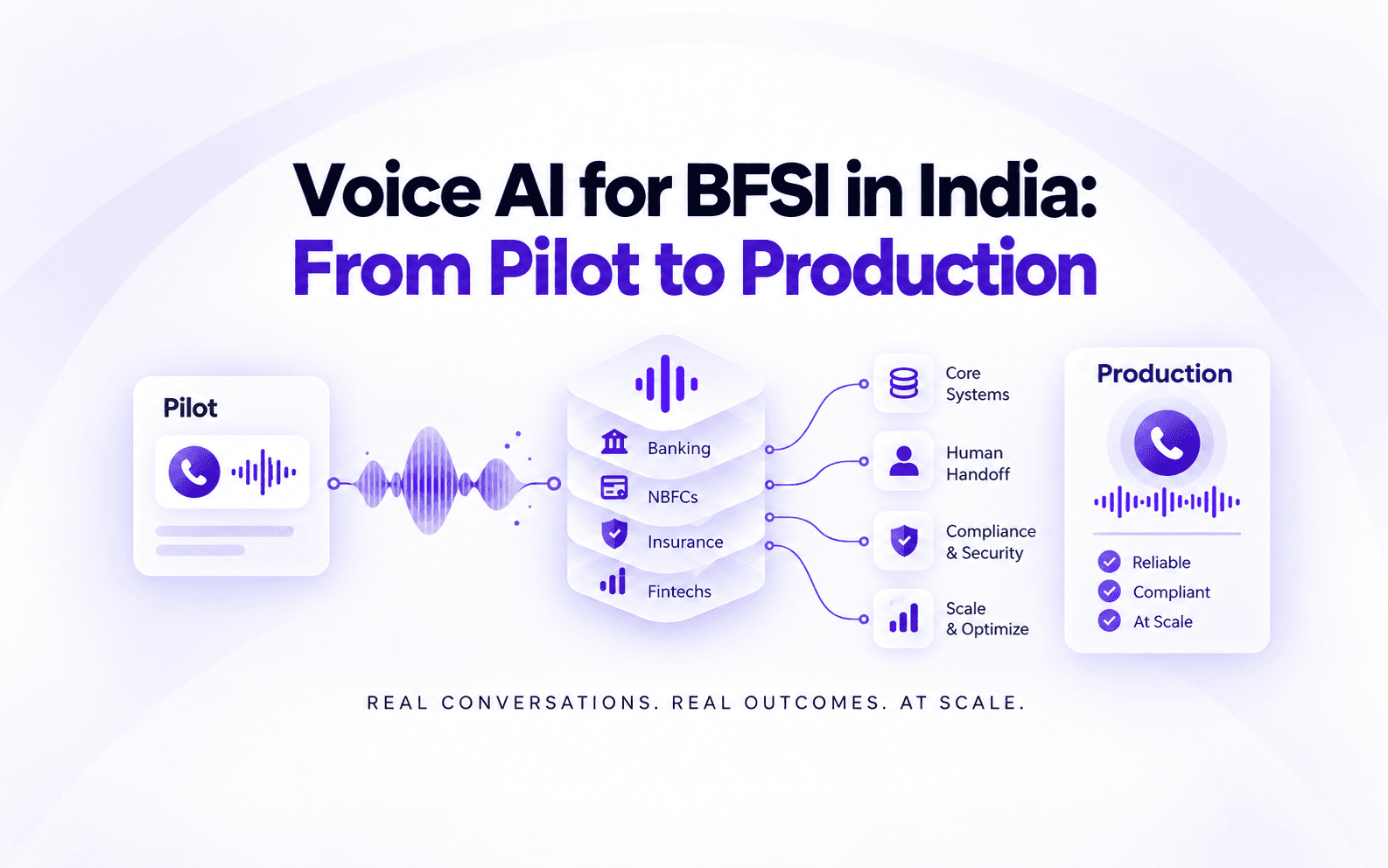
A Voice AI pilot can be deceptively convincing.
The calls sound natural. Customers respond. The agent gets through the script, and the dashboard shows a few hundred conversations handled without a human on the line. Then someone on the leadership team asks the question that actually matters: can we run this across our full customer base?
That's where the real work starts.
A successful pilot proves that a narrowly defined voice AI use case works under controlled conditions, a curated call list, a tight script, someone from the project team quietly reviewing every recording. It doesn't prove the system can hold up against production call volumes, real mobile audio, five regional accents in one shift, mid-conversation interruptions, a CRM that times out under load, or the compliance review that shows up the week before launch. For a bank, NBFC, insurer or fintech, that gap isn't a technicality, voice AI in BFSI sits inside a workflow that touches customer data, telephony infrastructure, loan or policy systems, human agents and regulatory obligations, all at once.
The real question isn't whether voice AI can be applied to Indian financial services, plenty of banks and NBFCs are already piloting it. The harder question is whether a deployment can be trusted at production scale, and how you find that out before the expensive way does it for you.
[Global Fintech Fest 2026](https://globalfintechfest.com/) runs September 8–11 in Mumbai, with Agentic AI as one of its central themes, a timely backdrop, though the pattern this article is about isn't tied to any one event. [NASSCOM](https://w.media/marginal-improvement-in-indias-ai-adoption-maturity-nasscom-report/) and EY's AI Adoption Index has repeatedly found that BFSI, unlike some other sectors, still leans toward a proof-of-concept-heavy AI strategy rather than a transformation-focused one, another way of saying plenty of pilots exist and comparatively few have made the full jump. This article is about closing that gap on purpose.
Why a Working Pilot Isn't the Same as a Production-Ready System
Most pilots are built to answer one relatively narrow question: does this specific use case work at all?
A lender tests payment reminders. An insurer tests lead qualification for a new product. A bank tests a service callback or an account-verification flow. An NBFC follows up on a missing loan document. The scope is deliberately small, and that's correct, a pilot should prove feasibility, not attempt full automation on day one.
The trouble is that pilots run under conditions production never offers. Call volumes are modest, the customer list is often the easier segment to reach, integrations frequently point at test data, and someone on the project team is usually listening closely enough to catch problems before they compound.
Production strips all of that away. The same system now has to handle thousands of calls a day instead of a few hundred, real mobile-network conditions, regional accents and mid-sentence code-switching, customers who interrupt or say "I already paid this," CRM and policy-system failures under load, a much higher volume of human handoffs, edge cases that never showed up in the test group, and real compliance scrutiny instead of a dry run.
Treating pilot success and production readiness as the same milestone is the single most common way BFSI voice AI projects stall after a promising start.
A Practical Model: Pilot → Validate → Scale → Optimize
A useful way to manage the transition is to treat it as four distinct stages, each answering a different question:
Pilot, Can voice AI do the job at all?
Validate, Does it hold up once real conversations get messy?
Scale, Can the business depend on it at volume?
Optimize, Is it actually making the business better, not just busier?
Each stage has its own test, and skipping one doesn't save time, it just moves the failure downstream, usually to a moment when a lot more customers are affected.
Stage 1: Pilot, Proving the Workflow, Not Automating Everything
The pilot should focus on one clearly bounded customer journey: a collections call about an upcoming EMI, an insurance lead-qualification flow, a banking service callback, an NBFC follow-up on a missing document. The goal isn't to automate the whole journey, it's to prove that this specific slice of it is technically feasible and commercially worth pursuing.
The easiest mistake at this stage is measuring the wrong thing. "How many calls connected?" is useful, but it isn't the funnel that matters. The real funnel looks more like: dialled → connected → engaged → completed → outcome captured → human follow-up (if needed). For collections, that becomes connected → payment intent understood → promise-to-pay captured → promise-to-pay kept. A connected call that ends in silence isn't a win just because the line stayed open.
Stage 2: Validate, Does It Survive a Real Conversation?
A controlled demo can make almost any voice system look impressive. Real customers are far less cooperative, in the useful sense. They interrupt, switch between Hindi and English mid-sentence, say "I already paid" before the agent finishes the disclosure, or ask to speak to a human from a moving auto-rickshaw with a weak signal.
Validation means deliberately introducing those conditions before volume goes up, not discovering them after.
Language. Test each target language and code-switching pattern separately, Hindi-English, Tamil-English, Telugu-English, and so on. A single blended "accuracy" number hides more than it reveals; a bank operating across five states needs to know how the agent performs in each one.
Speech conditions. Noisy environments, low speech volume, fast talkers, spoken account numbers, financial terminology, older callers, and regional accents all behave differently from clean studio audio.
Conversation resilience. Can the agent handle an interruption without losing the thread? Understand a correction ("no, the other loan")? A mature system should know when not to pretend it understood, a confidently wrong answer is worse than an honest "could you repeat that?"
What Breaks Once Volume Goes Up (It's Rarely the Model Itself)
A system that performs well across 500 calls can behave very differently at 5,000, not necessarily because the underlying model gets worse, but because volume increases everything around the model too.
| What breaks | Why a pilot can miss it | What changes at scale |
|---|---|---|
| Speech recognition | Cleaner, simpler test calls | More accents, background noise, mobile audio, code-switching |
| Latency | Low concurrency hides bottlenecks | ASR, orchestration, TTS, APIs and network hops compound |
| Interruptions | Pilot calls tend to follow the script | Real customers interrupt, correct, and change intent |
| Telephony | One controlled route may be enough | More carriers, codecs, dropped calls, network variation |
| Integrations | Limited test traffic | API limits, timeouts, retries, partial writes appear |
| Human handoff | Few escalations | More transfers, more context to preserve |
| Unsafe responses | Narrow scripts constrain the agent | Broader intents create more room for unsupported answers |
| Governance | Manual review is manageable | Thousands of recordings and exceptions pile up fast |
| Cost | Pilot volume keeps spend small | Minutes, retries, inference and human review accumulate |
| Business performance | Test populations tend to be easier | Lower-intent, more complex segments enter the mix |
This is the point where "the AI works" stops being a useful status update.
Stage 3: Scale, Can the Business Actually Depend On It?
Once validation is done, the next challenge is increasing volume without losing quality, customer experience, or control. Scaling the AI is not the same as scaling the workflow around it, you might be able to increase call volume technically without much trouble, but can your CRM updates keep pace? Human escalations? QA reviews? Compliance monitoring? A production deployment needs all of these pieces to scale together, not just the conversational layer.
That's the thinking behind five practical checkpoints, call them gates, worth clearing before a broad rollout.
Gate 1, The Real-Call Gate. Test on the channel customers actually use: live PSTN/SIP conditions, not a browser demo. That means packet loss, jitter, silence, dropped calls, voicemail, DTMF tones, codec variation, and disconnections. Measure latency end-to-end, across the whole chain.
Gate 2, The India-Language Gate. Don't ask "does the AI support Indian languages?" Ask how it performs for your customer segments specifically. Measure language, accent, dialect and code-switching performance separately rather than publishing one aggregate score, for a bank operating across multiple states, that's a customer-experience question, not a model-quality footnote.
Gate 3, The Workflow Gate. A voice agent can have a genuinely good conversation and still fail the business process behind it: the promise-to-pay doesn't write cleanly to the collections system, a CRM update silently fails when an auth token expires, an insurance lead gets qualified accurately but the human advisor receives no usable context at handoff. Testing needs to cover the whole chain, CRM, loan-origination systems, collections platforms, policy systems, payment workflows, including expired sessions, API limits, and partial writes.
Gate 4, The Control Gate. The more useful question isn't "can the AI handle this?" It's "should it?" A production system needs clear escalation boundaries: low speech confidence, ambiguous intent, complaints, fraud indicators, vulnerability signals, or a customer explicitly asking for a human. The point isn't eliminating people from the process, it's making the handoff deliberate, and making sure the customer doesn't have to repeat themselves once it happens.
Gate 5, The Scale Stress Test. This is the most practical stress test in the framework, and it's worth being precise about what it is: a way of thinking about headroom, not a regulatory requirement or an industry benchmark. Not every deployment needs to literally hit ten times pilot volume before going live. But before a broad rollout, it's worth testing a materially larger load than the pilot ever saw, often through a staged 2× → 5× → 10× ramp, while tracking agreed thresholds for latency, failure rate, speech quality, workflow accuracy, and cost. The point is finding out what breaks before your customers do, not producing a number for a slide.
Stage 4: Optimize, Is Voice AI Actually Making the Business Better?
Once the system is stable, the question changes: is it producing a better outcome than what it replaced?
Technical metrics show whether the infrastructure is healthy: availability, failure and drop rates, latency (P50/P95/P99), speech-recognition accuracy by language, API success rates, and recovery time after incidents.
Conversation metrics show whether the interaction itself is working: task-completion rate, first-call resolution, transfer success, the repeat-explanation rate (how often the agent restates something the customer already heard), customer-requested-human rate, and unsupported-claim rate. Containment isn't the same as resolution, a call that never reaches a human isn't automatically a successful one.
Workflow metrics show whether the AI is participating in the business process correctly, not just talking well: CRM action-completion rate, correct-disposition rate, exception-routing accuracy, and the transfer-summary correction rate (how often a human agent has to fix the handoff notes before acting on them). This is often where the real enterprise value sits.
One more pair worth tracking: the override rate (how often a human reverses an AI action) and the appropriate-override rate (how often that reversal, on review, was actually the right call). The first shows how much humans are still correcting the system; the second shows whether the correction was necessary, a far better signal than a vague "acceptance rate."
The Metrics the Executive Team Actually Cares About
Nobody in the boardroom asks how many tokens got processed. For collections, that's promise-to-pay-kept rate and cure rate. For insurance, qualified-lead rate and verified conversion. For customer operations, first-call resolution and repeat-contact reduction. Across all of them, one number tends to matter most: cost per completed outcome, not cost per connected call, a cheap call that doesn't resolve anything is still an expensive way to not solve a problem.
Compliance Is a Production Requirement, Not a Pre-Launch Checklist
Compliance shouldn't show up for the first time a week before go-live. It needs to be part of the deployment architecture from the start: What data does the agent receive? Where is the transcript processed? What gets retained, and for how long? What requires human sign-off? How are high-risk interactions escalated?
India doesn't have a single "Voice AI law," but it isn't a regulatory vacuum either. A handful of developments are worth knowing specifically:
RBI's FREE-AI framework [RBI, Aug 2025] set out seven guiding principles and 26 recommendations across six focus areas [KPMG, Sept 2025] for how banks, NBFCs and fintechs should govern AI. It wasn't binding regulation on its own.
A step closer to enforceable arrived in June 2026, when the RBI released a draft "Guidance on Regulatory Principles for Model Risk Management" for public consultation [S&R Associates, June 2026]. It's still a draft. Comments closed July 24, 2026, and no final version has been issued yet, but the draft applies to AI and machine-learning models used by regulated entities, directly or through vendors, and puts validation accountability on the regulated entity itself, not the vendor. Enterprises running voice AI should assess with their own compliance and legal teams whether their specific workflow falls within its scope, rather than assuming a platform's compliance claims cover it. Some summaries of the draft also describe proposed customer-facing AI disclosure requirements [CorpLawUpdates, June 2026], though final wording depends on what survives consultation.
The DPDP Act's rules, notified in November 2025, roll out in three phases through May 2027, the Data Protection Board is established now, Consent Manager registration activates around November 2026, and full consent and data-rights obligations become mandatory the following May [India Briefing ]. Build for the 2027 requirements now, not just what's enforceable this quarter.
TRAI's existing telemarketing framework: DND/NCPR, DLT-based sender registration, and the 140-series versus 160-series number distinction [TRAI], official already apply to any outbound commercial call, AI-placed or not. A finalized, AI-specific disclosure mandate from TRAI doesn't yet exist; the safer posture is disclosure-by-default.
IRDAI formed a seven-member AI working group in June 2026, chaired by IIT Hyderabad's Sandeep Shukla [Business Standard, June 2026], mandated to cover claims processing and fraud detection, functions where automated decisions carry the most policyholder risk [Insurance Business Asia]
The posture that follows from all of this hasn't changed: "our vendor is compliant" isn't enough. "Our specific workflow has been mapped and signed off against what actually applies to it" is.
(This section is a workflow-risk map for planning purposes, not legal advice. Several items above are still in draft, confirm current status with your compliance and legal teams before launch.)
A BFSI Voice AI Production-Readiness Scorecard
A scorecard turns a vague discussion into an actual launch decision. Score each category from 0 to 5:
| Category | What to measure | Evidence |
|---|---|---|
| Technical reliability | Availability, failure rate, latency, concurrency, recovery | Load tests, carrier tests, incident runbook |
| Speech & conversation | Language performance, task success, repeat-explanation rate | Representative test set, scored calls |
| Workflow integrity | API success, data writes, handoffs, exception routing | End-to-end production-like testing |
| Business outcomes | Resolution, conversion, PTP-kept rate, cost per outcome | Baseline comparison |
| Compliance & governance | Disclosure, consent, auditability, approvals | Compliance sign-off, audit samples |
| Operational readiness | Owners, QA, support, escalation, rollback | RACI, SOPs, incident exercises |
Go/No-Go: Don't Scale Yet If...
Hold off on a broad rollout if any of these are still true:
- Critical integration failures remain unresolved
- Language performance hasn't been validated against your actual customer mix
- Human escalation isn't reliable under load
- Compliance ownership for the workflow is unclear
- Production-load testing hasn't actually happened yet
- No rollback or incident-response process exists
None of these is a reason to abandon the deployment, each one points back to a specific gate above.
Before You Scale: Run Your Own Scale Stress Test
A fast gut-check for any team sitting on a working pilot: what would break first if tomorrow's volume were ten times larger than today's, telephony, language quality, CRM integration, escalation capacity, compliance review? The answer points straight at the real remaining work, which is the whole point of Gate 5: expose the weaknesses before the volume gets real, not after.
Where GoodBox Fits
An enterprise voice AI platform's job is bigger than placing outbound calls or answering inbound ones. A production deployment needs the conversation layer to work in step with telephony, business systems, human teams, controls and measurement, all at once, not as separate projects.
GoodBox works with BFSI teams across that broader workflow: multilingual customer conversations, telephony orchestration, system integrations, human handoff, quality monitoring, and outcome measurement. The specifics of any platform, including GoodBox's, should be evaluated against your actual workflow requirements; pricing and technical documentation are worth reviewing directly.
Conclusion: From Pilot to Production
Whether an AI agent can hold a conversation with a customer isn't really in question anymore, it can. What's still being figured out, deployment by deployment, is whether the system around it can understand, act, integrate, escalate, recover and stay governed once the volume gets real.
That's the case for the four-stage model, the five gates, and the scorecard above. The milestone that actually matters was never "the AI works." It's whether the business can trust it at scale, and whether that trust is backed by evidence, not a demo.
Frequently Asked Questions
What's the difference between a Voice AI pilot and a production-ready deployment?
A pilot proves a narrow use case works under controlled conditions. Production-ready means the same system holds up under real call volume, network conditions, broader accents and intents, full system integrations, and active compliance oversight, without someone quietly catching problems behind the scenes.
How should BFSI teams test Voice AI performance across Indian languages?
Test each target language and code-switching pattern separately rather than relying on one blended accuracy score, and test against real speech conditions, background noise, fast speech, regional accents, not just clean studio audio.
What typically breaks when a Voice AI pilot scales to full production volume?
Rarely the core model itself. More often it's speech recognition under real acoustic conditions, latency across the full processing chain, telephony reliability across carriers, integration failures under load, and the operational load of reviewing far more exceptions than a pilot ever generated.
What compliance requirements apply to Voice AI in Indian BFSI?
There's no single "Voice AI law." Several frameworks intersect depending on the institution and use case, RBI's FREE-AI and draft Model Risk Management guidance, the DPDP Act's phased rules, TRAI's telemarketing rules, and (for insurers) IRDAI's AI working group. Map your specific workflow against what actually applies, rather than assuming a vendor's compliance claim covers you.
What is the Scale Stress Test for Voice AI, and is it required?
It's a stress-testing concept, a staged 2×→5×→10× ramp used to check how the system performs at a materially higher volume than the pilot. It isn't a regulatory or industry-wide requirement. Not every deployment needs to hit ten times pilot volume, but testing meaningfully above pilot load catches problems before customers do.
Which metrics matter most for measuring Voice AI success in BFSI?
Metrics work in layers: technical (latency, availability, ASR accuracy), conversation (task completion, repeat-explanation rate), workflow (CRM accuracy, exception routing), and business outcome (promise-to-pay-kept rate, cost per completed outcome, not just cost per call).
How long does it take to move Voice AI from pilot to production in BFSI?
There's no fixed timeline, it depends on integration complexity, how many languages are in scope, and how many of the five production gates need remediation before they clear. Teams that treat pilot and production as the same milestone tend to take longer, because problems surface after launch instead of before it.
What is a Voice AI production-readiness scorecard?
A structured way to score a deployment (typically 0–5) across technical reliability, speech quality, workflow integrity, business outcomes, compliance and governance, and operational readiness, turning "is this ready?" into a specific, evidence-backed decision.
Does Voice AI need to be disclosed to BFSI customers?
There's no single finalized rule mandating this across every use case yet, but the direction of travel points that way, RBI's June 2026 draft Model Risk Management guidance is reported to include customer-facing AI disclosure among its proposed requirements. Building disclosure into the call flow now is safer than retrofitting it later.
How should call recordings be handled?
Treat them as sensitive customer data: define retention periods, restrict access to what each role actually needs, redact sensitive fields like account numbers where possible, and ensure recordings can be produced for an audit or a customer's data-access request under the DPDP Act.
What should a BFSI Voice AI vendor provide during procurement?
Evidence, not claims: real-call test results rather than demo recordings, language performance broken down by segment, documented data flows, and enough transparency for your own team to independently validate the system, a vendor's certification doesn't discharge your own validation obligation.
What happens when an AI agent makes an incorrect decision, and how should human escalation be tested?
That's what the control gate and override-rate metrics are for. A production system needs a clear escalation path, a fast way to correct the error, and a review process that asks not just "did a human catch it?" but "was the override actually necessary?" Test escalation by deliberately triggering it before launch and confirming the handoff carries full context.